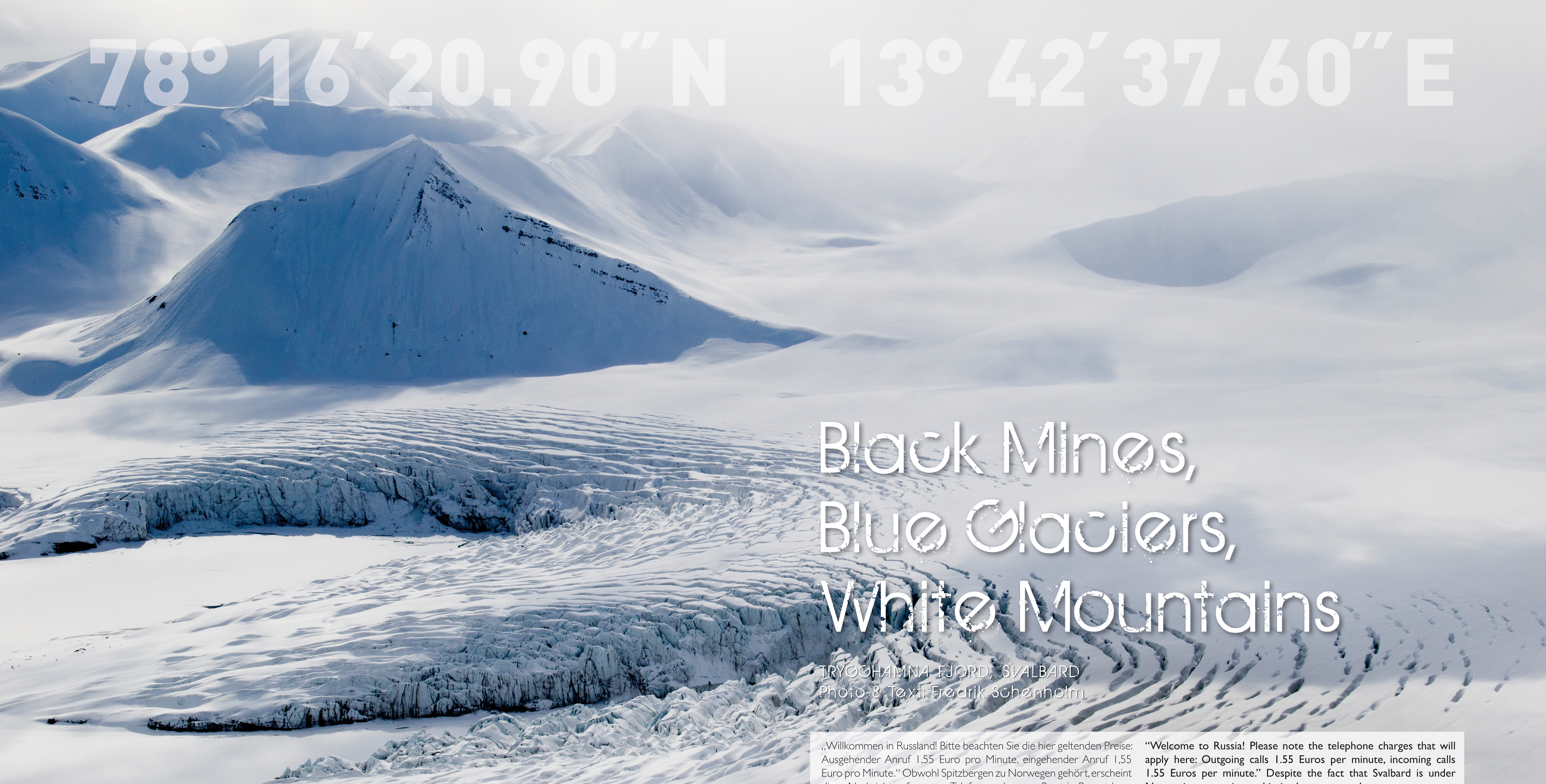
Spitzbergen / Svalbard · Trygghamna Fjord
Black Mines, Blue Glaciers, White Mountains
Issue 2018 · Words: Fredrik Schenholm · Photos: Fredrik Schenholm · 5 min read
"Welcome to Russia! Please note the telephone charges that will apply here: Outgoing calls 1.55 Euros per minute, incoming calls 1.55 Euros per minute." Despite the fact that Svalbard is under …
"Welcome to Russia! Please note the telephone charges that will apply here: Outgoing calls 1.55 Euros per minute, incoming calls 1.55 Euros per minute." Despite the fact that Svalbard is under Norwegian sovereignty, this is the message that pops up on our phone displays as our boat arrives in Barentsburg. From the harbor, there is a long and frayed wooden staircase leading past dilapidated wooden houses to higher elevations. An empty swing rocks back and forth in the wind. Looking towards the south, we see large piles of black coal. In the village, there is a small main street with a few houses, a school, a hotel that has seen better times, and a pub.
The group wants to have an "Arctic beer," and we head to what is said to be the northernmost brewery in the world. The tavern is empty; the only person present is a young Russian behind the bar named Kiril. He pours up seven locally produced IPAs at the cost of 15 Euros, which is roughly the price of one single beer in Oslo. "About 450 people are working in the coal mine", Kiril tells us. "The workers usually come here on three-year contracts, but I know one guy who's been here for 15 years." Barentsburg is located approximately 60 kilometers west of Longyearbyen, a small mining town on the island of Spitsbergen in the Norwegian archipelago of Svalbard.
Coal mining is the dominant economy, but recently the tourism industry has also generated some income for the locals. The name Barentsburg comes from the Dutch explorer William Barentsz, who discovered Svalbard in 1596. Since 1932, the Soviet Union (now Russia) and the Trust Arktikugol company have been responsible for the mining operations in Barentsburg. Five days earlier we arrived by plane from Oslo to Longyearbyen, which is located directly on the ice fjord on the west side of Svalbard. From the plane, we already got an impression of what awaited us: white mountains, blue water and huge glaciers.
For the next days, a boat, the Strønstad, would be our home for the experienced Swedish mountain guides Christian Edelstam and Magnus Lindor Strand, ten excited skiers and four crewmembers. Due to the lack of infrastructure on Svalbard, a boat is the best way to get around the islands. Just before our first dinner, the guides gathered everyone in the canteen for a briefing: "We identified three hazards: avalanches, crevasses, and polar bears. We figured you were the least familiar with the latter. If a polar bear shows up, it is important that we stand in a group formation and shout. Most likely, the bear will go away." Mountain guide Christian took a short break and continued: "If that doesn't work, we use our signal gun.
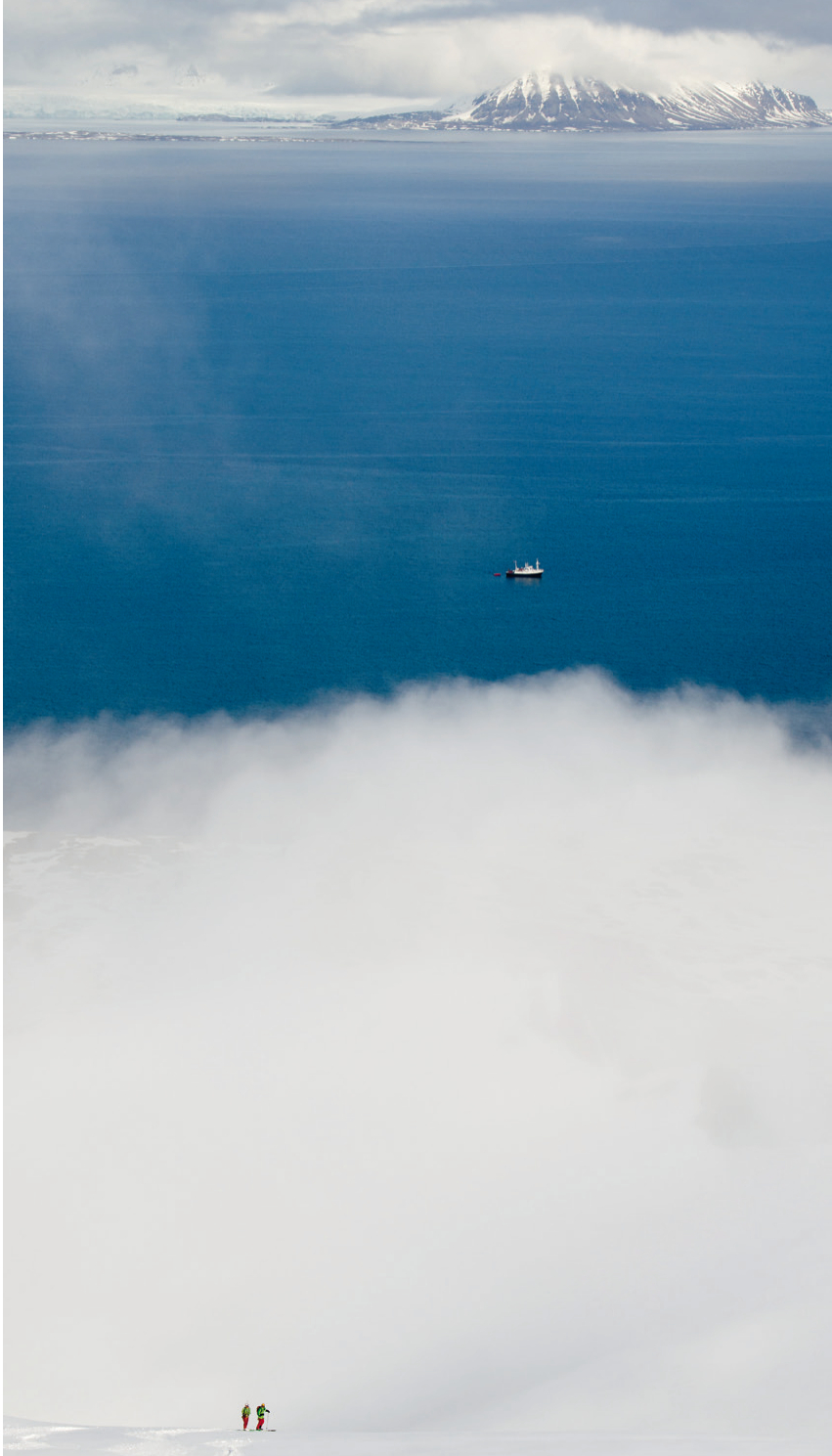
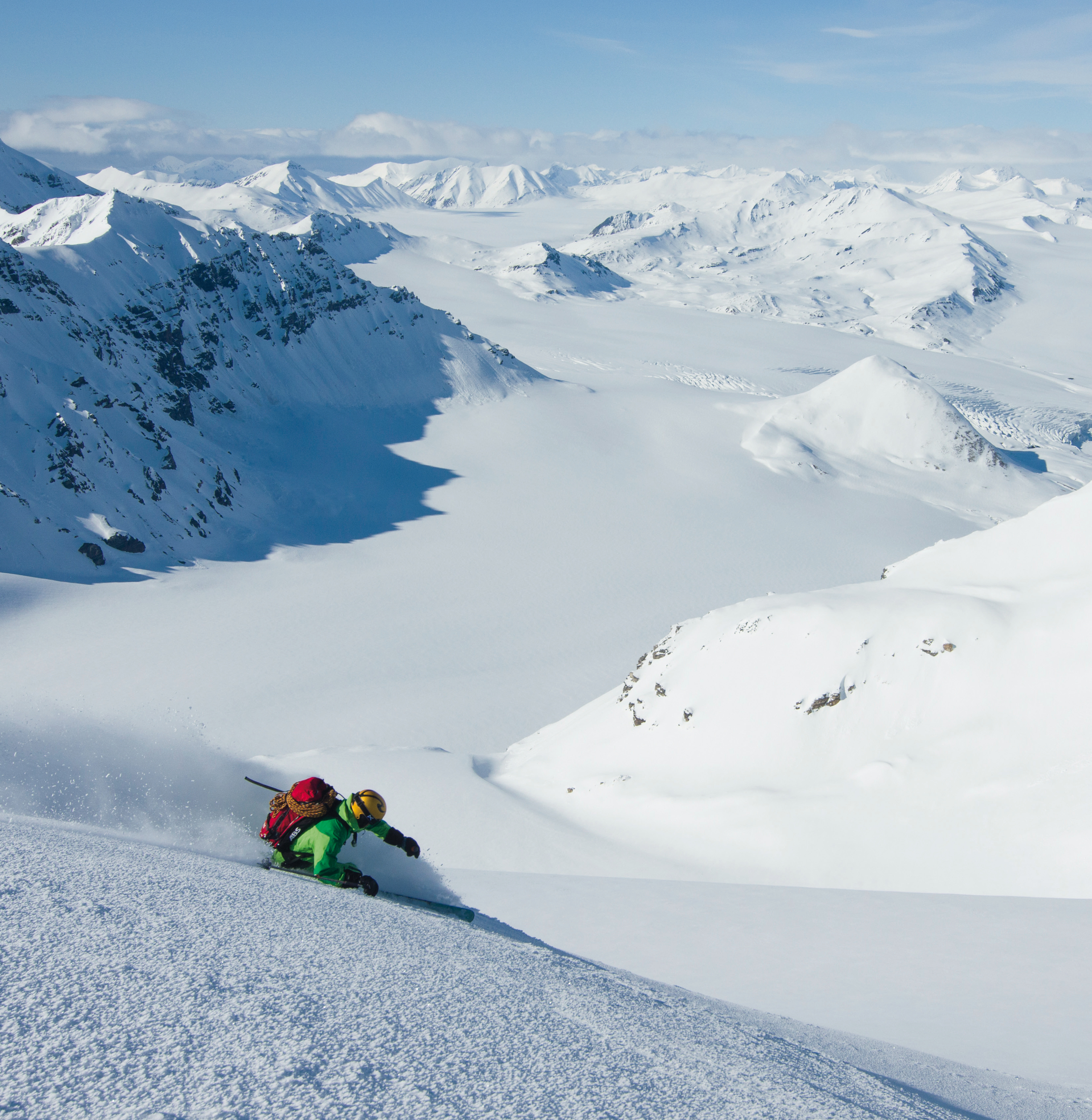
If that doesn't work, we shoot a warning shot with our rifle. If the polar bear still doesn't go away and comes towards us, you probably know what will happen next. That's very unlikely.... but it's possible." After dinner, the Strønstad left the port heading west across the Isfjorden and into the Trygghamna fjord. After a shaky three-hour journey, we reached the calm waters of the fjord. Our skipper, Ivar, set anchor and went to bed. The following morning, the group got ready for the first ski tour in this magnificent arctic landscape surrounding the boat: massive glaciers all the way to the fjord and sharp, white peaks all around. Christian and Magnus had their binoculars glued to their faces scanning the coastal strip for polar bears.
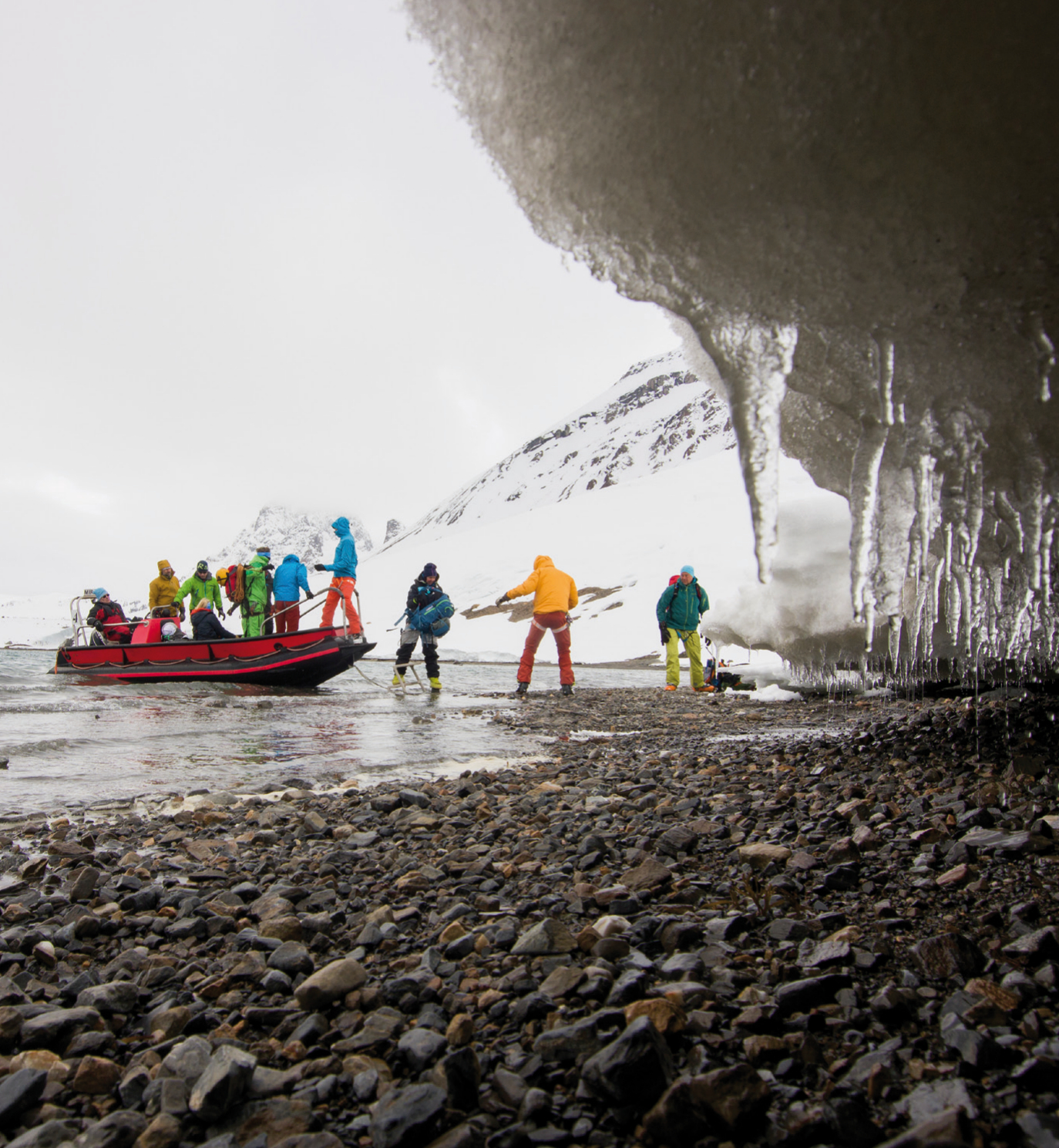
The group was waiting to board the dinghy that would take us to the coast. Svalbard is a group of many islands, and the largest one is Spitsbergen. All the islands together make up about 1/10 of the size of France, 60% of the land area consists of glaciers. On the western side of Svalbard, where most of the commercial skiing is taking place, the average precipitation is 400 millimeters per year. On the more remote eastern side, you get up to 1,000 millimeters. The average annual temperature rarely exceeds 0 degree Celsius, which means that rainfall usually hits the ground in the form of snow. The mission was to ski 849-meter Protector Mountain. Everyone quickly got off the dinghy and moved to higher grounds.
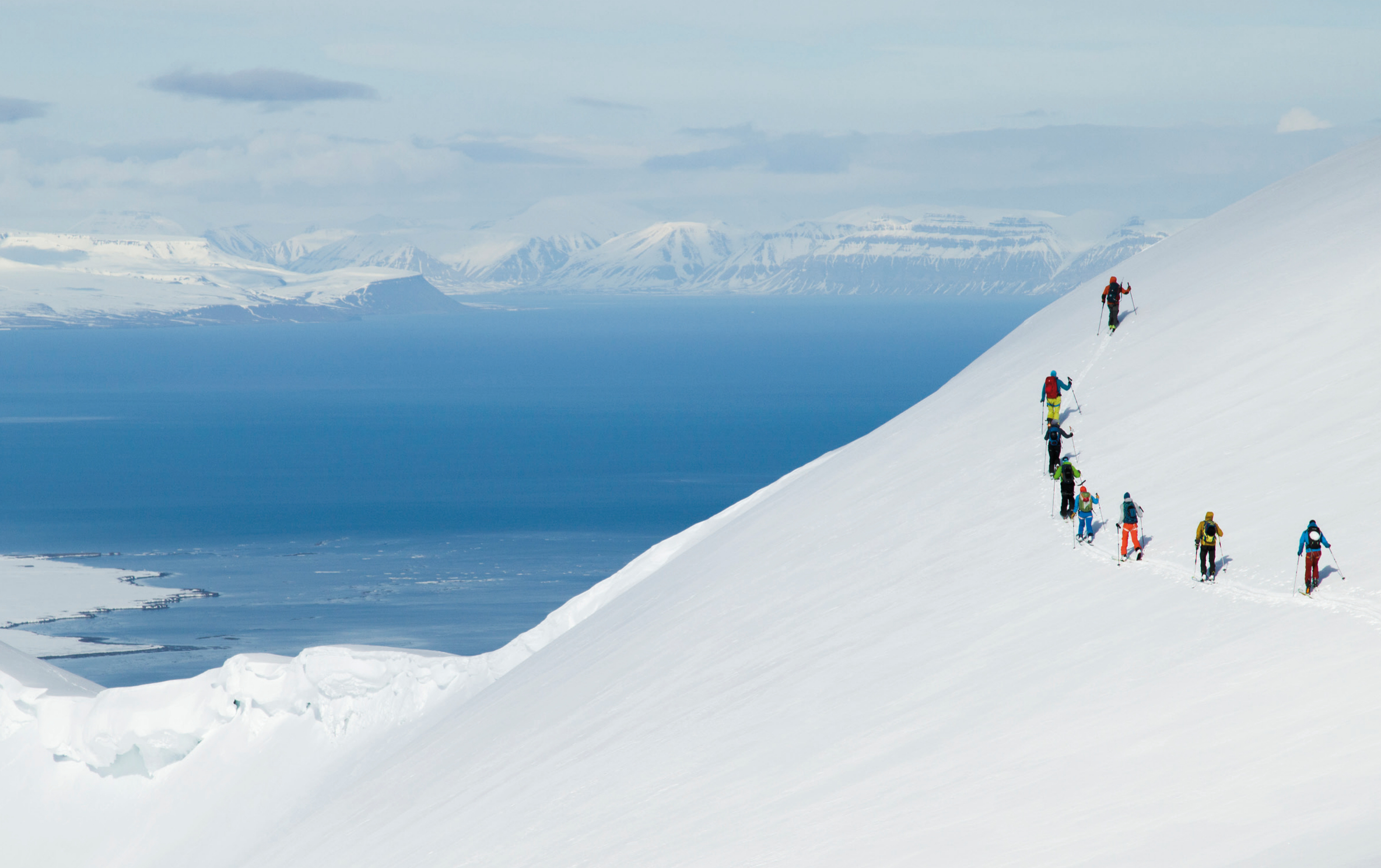
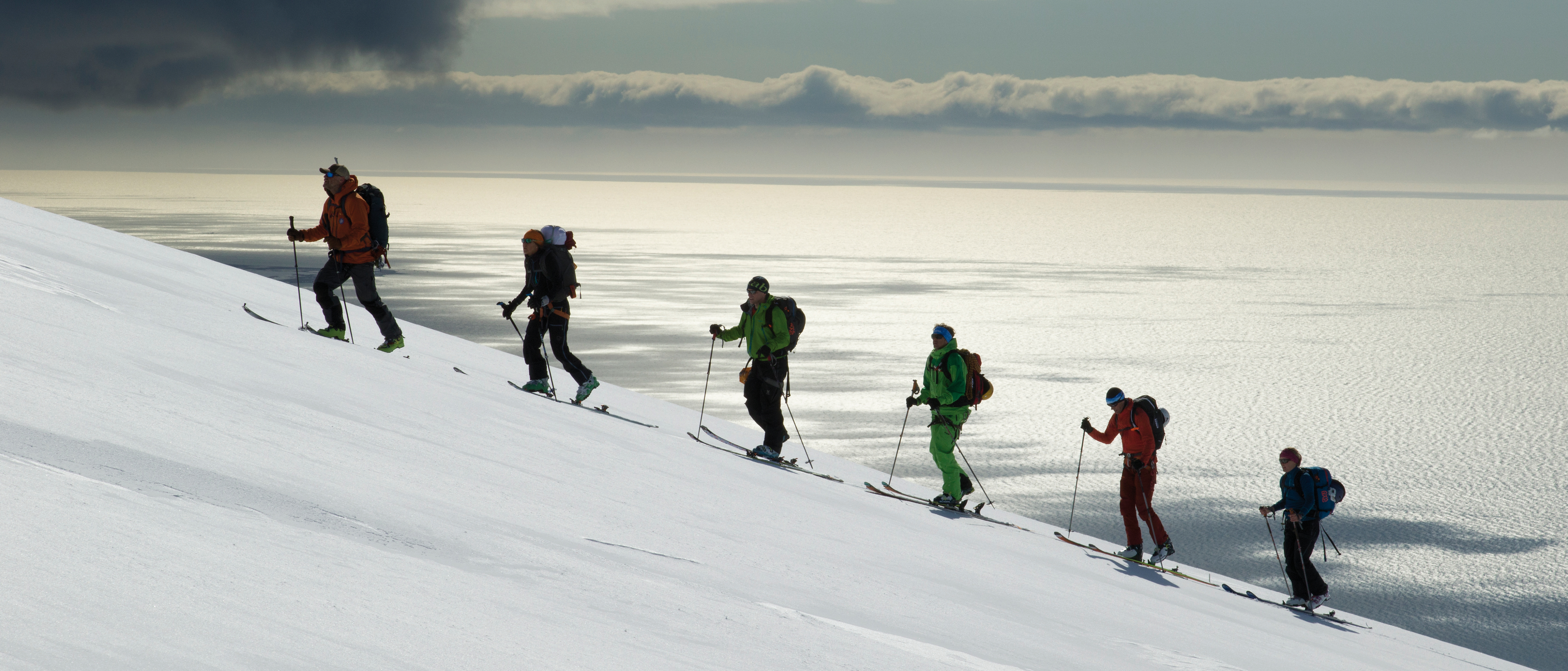
No unnecessary time was spent in the polar bear zone. The view got better and better the higher we got. From the summit, we saw the plateaus on the other side of the Isfjord, part of Trygghamna fjord, with glaciers that reach directly to the water. We drooled over all the possibilities. So much to do, so little time. The group skied two runs, one down the western slopes to the sea and a steeper one down towards the north to Protectorbreen. The snow varied from perfect spring corn to a thin crust layer on the northern side. Nine hours later, we sat exhausted but happy in the dinghy heading back to the Strønstad. The mountains on Svalbard are generally not very high.
Along the west coast, they hardly reach 1,000 meters, and much of the skiing takes place on elevations of 500 to 800 meters above sea level. This may seem low, but it's high-quality vertical. The highest mountains are located on the northeastern part of Spitsbergen in the Atomfjella mountain range with Svalbard's highest peak, the Newtontoppen 1,713 meters. The anchor was hoisted, and we left Trygghamna. The plan for the next days was to ski on Prince Charles Forland and the mountains around Ny-Ålesund. Prince Charles Forland is a narrow, long island west of Spitsbergen with various mountains and lots of ski touring potential. When we didn't ski, we spent our time playing games, sitting in the sauna, hot tubbing or doing other things.
In between, we'd see a walrus, maybe a polar bear, a seal or an iceberg. The entire trip was an incredible outdoor experience including world-class ski touring. It's simply a must for every ski mountaineer looking for something that will be hard to beat. Or what would you do after Svalbard?