Schweiz · Bernese Alps (Mönch / Fiescherhorn)
Steep and Wild
Issue 2020 · Words: Christian Penning · Photos: Christian Penning · 5 min read
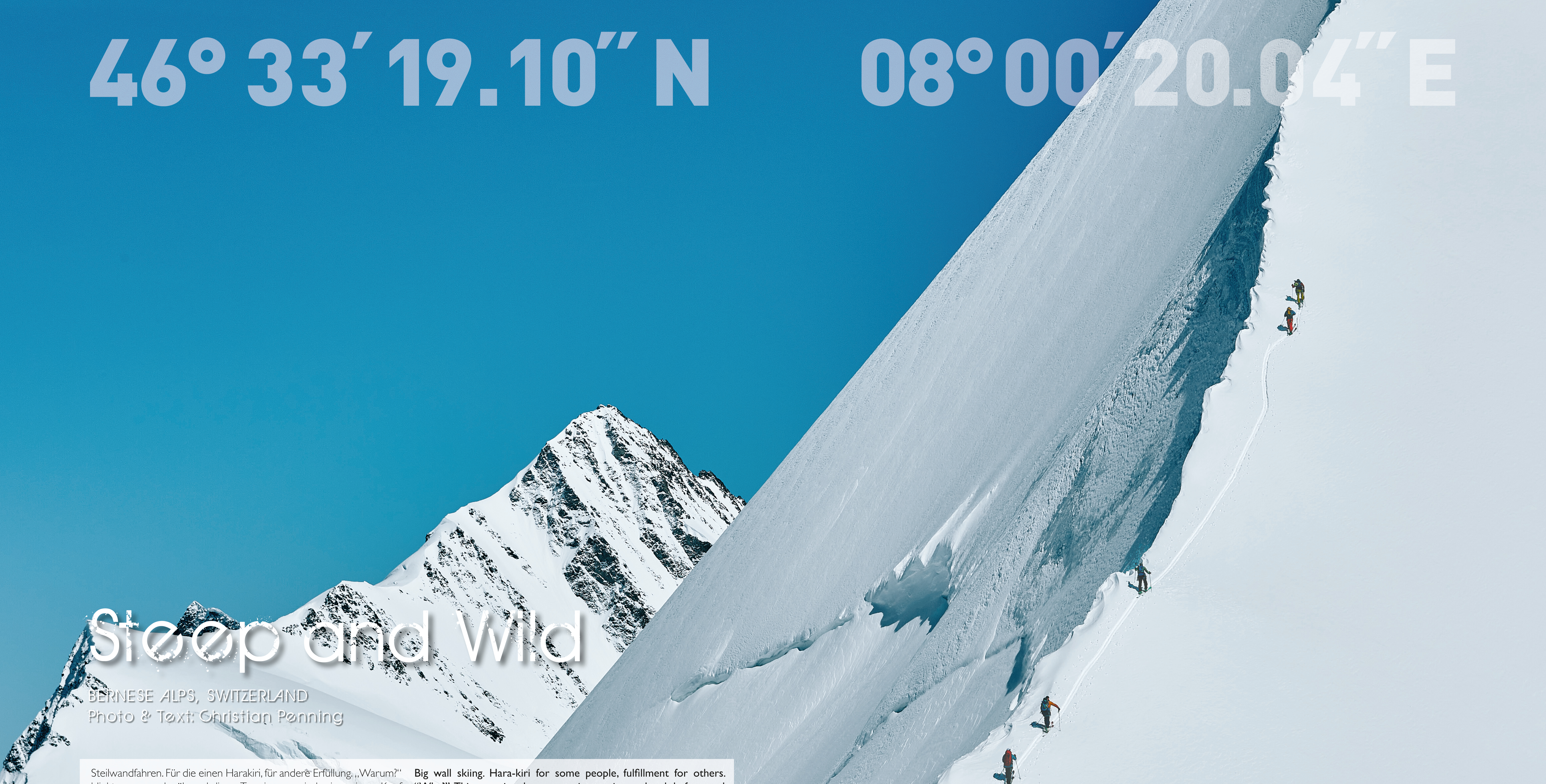
Big wall skiing. Hara-kiri for some people, fulfillment for others. "Why?" This question keeps popping up in my head, before and during this adventure. Why would you do something like that? I've done …
Big wall skiing. Hara-kiri for some people, fulfillment for others. "Why?" This question keeps popping up in my head, before and during this adventure. Why would you do something like that? I've done many interviews on this question with some of the pioneers of big wall skiing and professional athletes. And now I find myself in the middle of it. Together with my own experiences the fragments of interviews from the past are now mixing up to a melange of respect in my head. Respect is precisely the right attitude for the next days' projects: the jagged flanks of Mönch (13,474 feet) and Fiescherhorn (13,284 feet).
Great chapters of alpine history have been written in the area, from the first ascent of the Eiger north face to spectacular first-time descents like those of two Italians named Toni Valeruz and Bruno Pederiva. In 1983 they succeeded and conquered the Eiger north-eastern face – 55 degrees on skis, which until then had been believed to be impossible. Because there was no recorded evidence, Valeruz climbed up in front of TV cameras the next day and skied back down again – by himself. Chris Kohler from Bern was still a little boy at that time. But the story of this heroic achievement impressed him so much that the desire to master similar descents captivated him ever since.
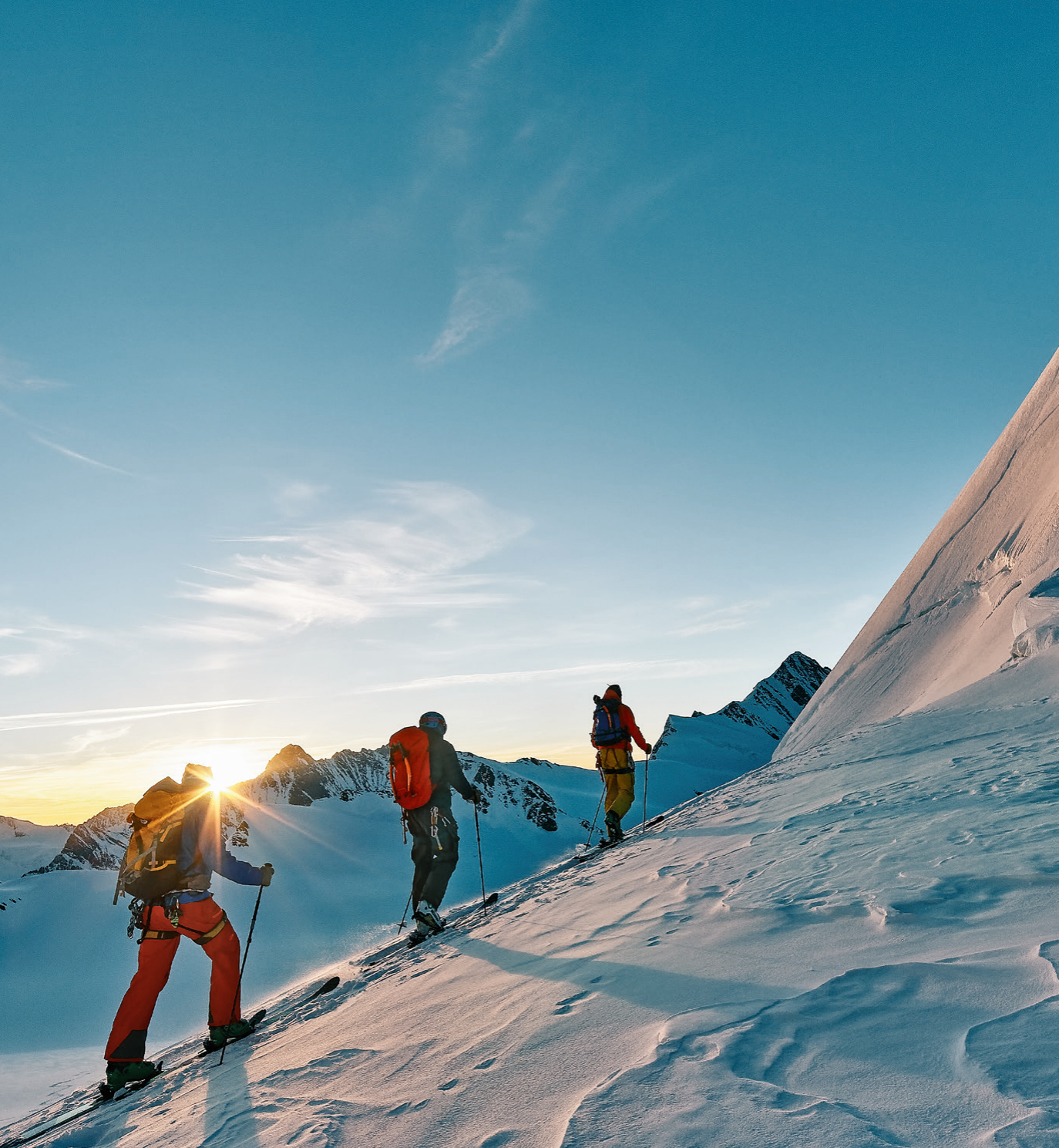
Today, decades later, Chris is sitting in front of the Mönchsjoch hut, discussing the details of the next days with his companions. It's not the first big wall adventure that Chris and his buddies are about to tackle. Thanks to a solid mountaineering education in the Swiss Alpine Club, and as an officer of the Swiss alpine military troops with a deep passion for freeriding, the Swiss has long since fulfilled his childhood dreams. "To go steep," in colloquial German, also means "to go for it" or "to rock 'n roll." But to go steep on a mountain means, above all, to move and act in a controlled and responsible way. The next morning, Chris and his rope partner Christian scramble up the exposed, rocky south-east ridge to the summit of Mönch.
"More than by the sole thrill of the descent, I'm attracted by projects that just come out of nowhere. I am not talking about resort freeriding," Chris ponders during a short breather. For weeks, sometimes for years, he observes the conditions in a desired wall and face, gathering information, and devising strategies until the conditions are finally perfect. "The adventure begins long before I set foot on the mountain – it all happens in my head first." Chris learned this meticulous way of prepping an objective from Toni Valeruz. Toni used to prepare every descent in a highly professional manner, down to the smallest detail. "One of the most important things is that you keep your sense of orientation," says Chris.
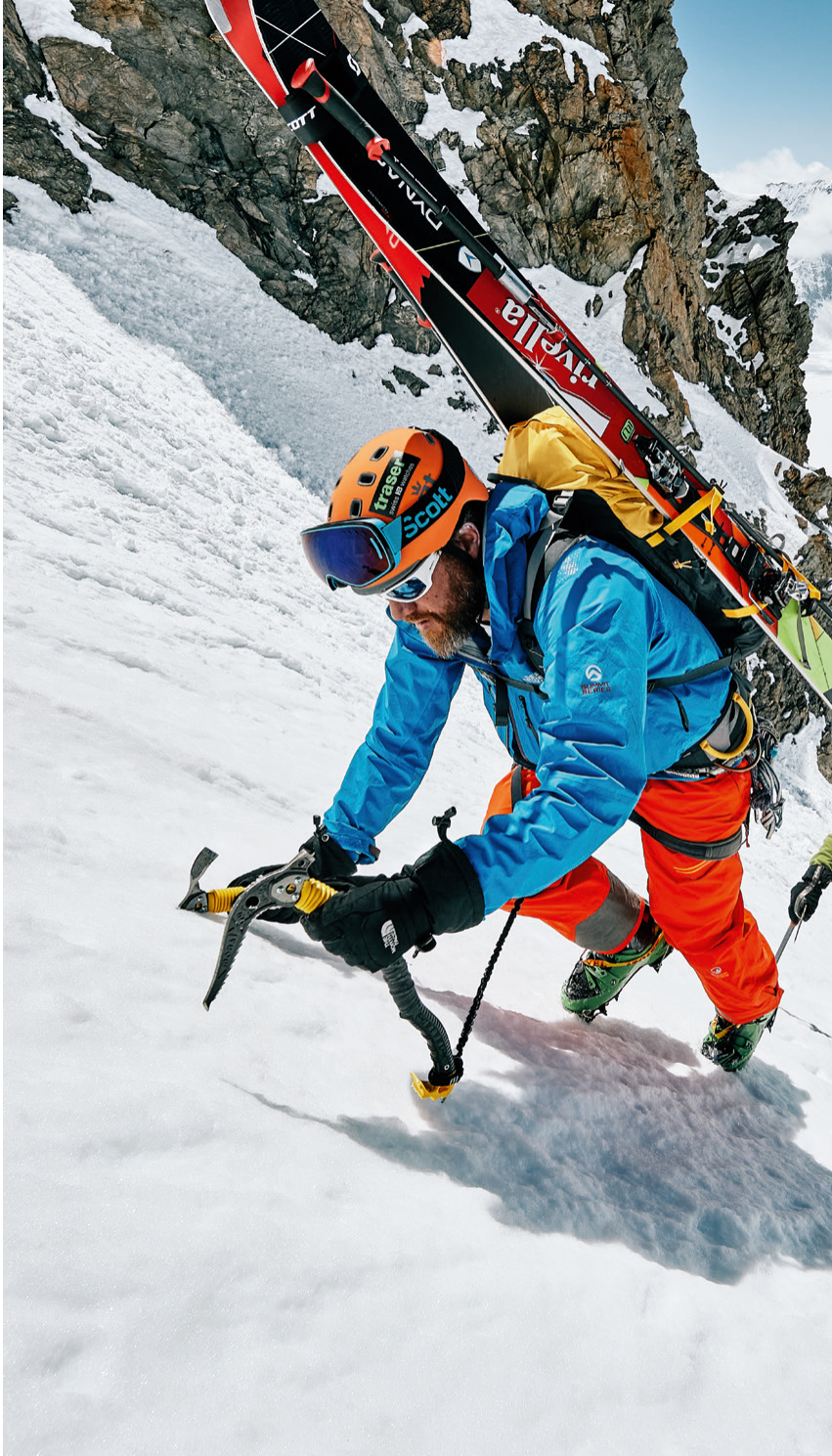
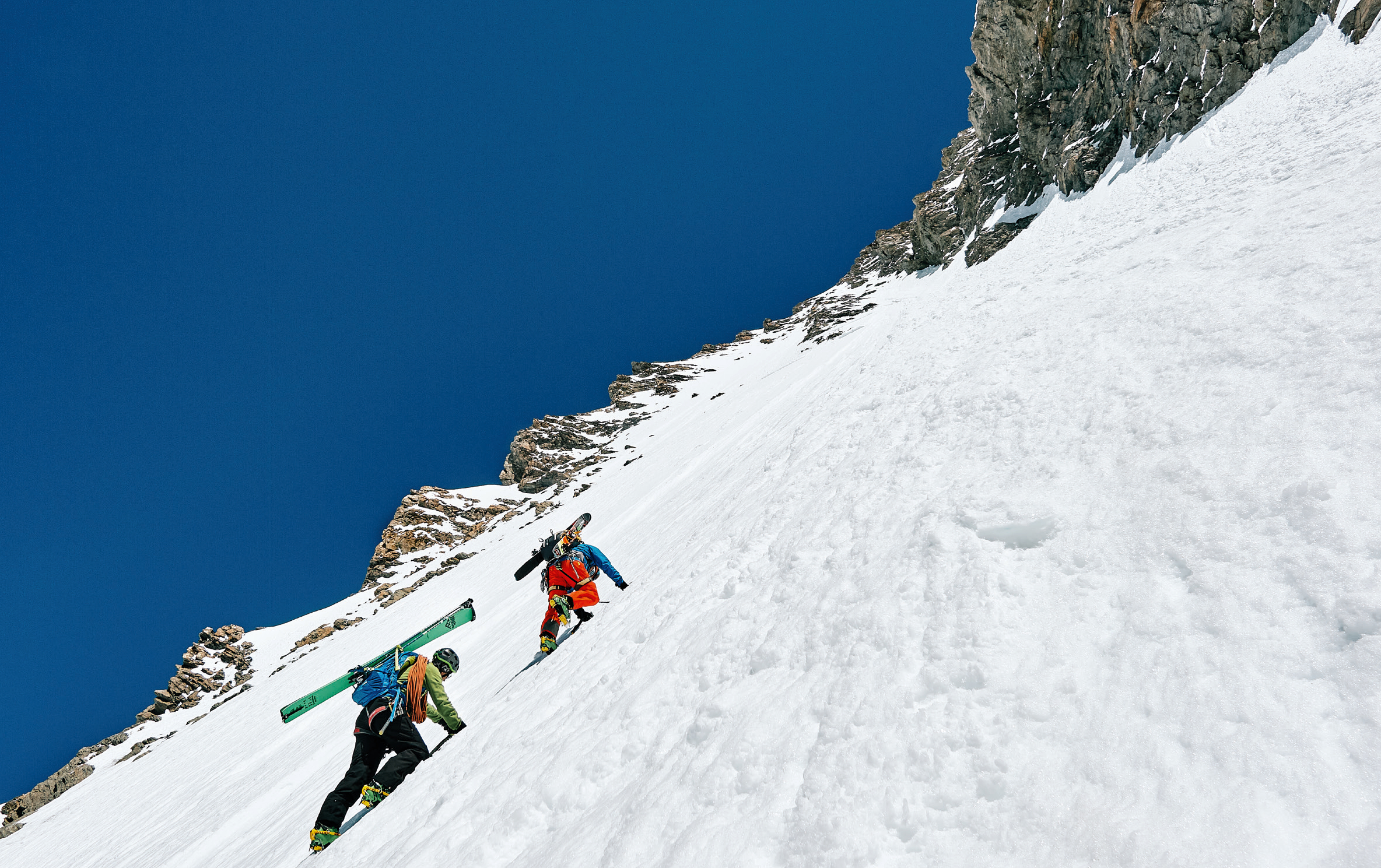
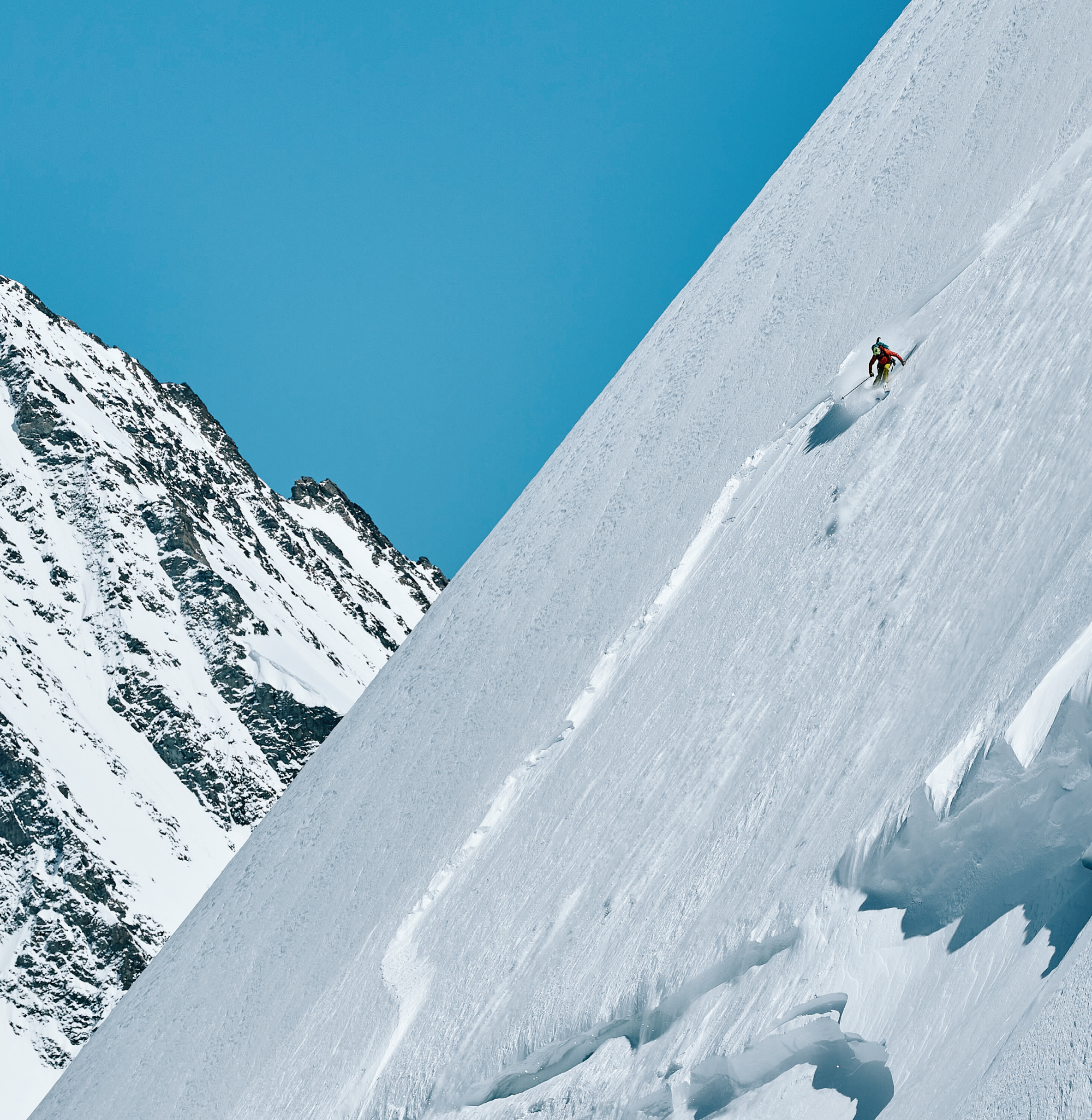
An hour later, he carefully places the first turns in the perfect spring corn in the extremely steep south face of the Mönch. One tumble, or one uncontrolled turn, and you'd disappear forever between those icy crevasses, the size of bell towers, a couple of hundred meters below us. The next day, when we set out to climb the Fiescherhorn, the mountain looks like a planet of ice and stone, topped by impressive rock spires. "Conquests of the void," is what big wall legend Heini Holzer once called his projects. The skis on the rucksack, crampons on your feet, ice axes in your hands – every single step feels like a squat with a heavy dumbbell attached to your shoulders. Breathing turns into heavy snorting. The air literally becomes thin.
"A big wall descent is only the tip of the iceberg," the South Tyrolean mountain guide Franceso Tremolada once told me. "To reach it, you need a lot of training and routine." Many people underestimate the hardship and simply do not have enough alpine experience, he said. Climbing the icy slope of the Fiescherhorn, every step must be perfect. As we reach the last ridge leading to the summit, we are exhausted. The view down the mountain reminds me of the view from a helicopter. My pulse is only slowly calming down. "What's most beautiful about these kinds of experiences is the freedom and tranquillity," Chris ponders. "No rush; no first-line rivalry like in freeriding." The silence is almost tangible.
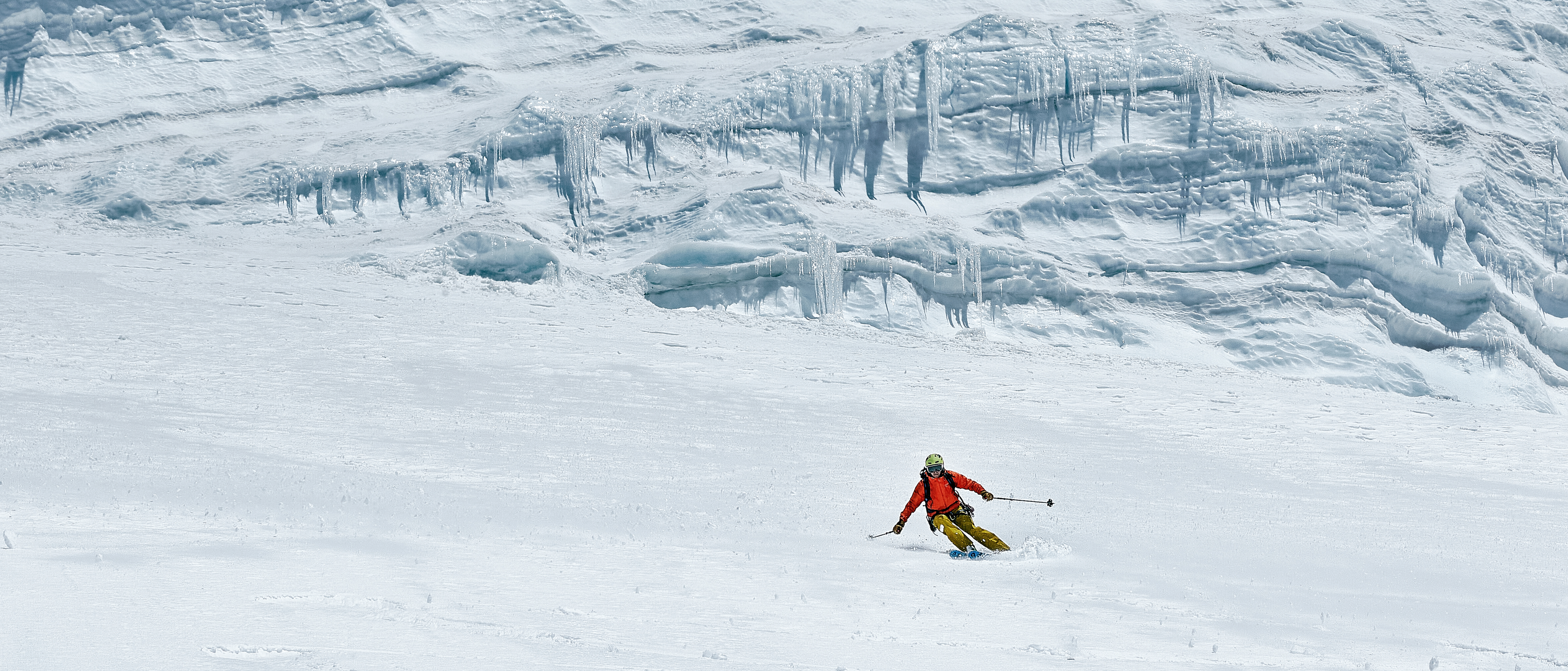
Half an hour later, the sun has softened the icy snow cover. "Now or never." Chris takes the first turn. He's fully focused. This exceptional intensity is resulting in a state of flow also known from challenging climbing routes. All you think about is your next turn. Body and mind melt into an otherwise never experienced unity. 2,500 feet below, tension and joy discharge into collective exultation. We high five each other. What's left is a liberating pleasure run across the so-called "eternal snow field" to the Konkordia hut. A sense of deep satisfaction emerges. Big wall skiing is one of the last alpine disciplines without competitive rules; one of the last refuges for individualistic adventurers.
When asked as a young man what motivated him to ski the steepest mountains, big wall pioneer Sylvain Saudan – now 80+ years old and the first person who skied the Monte Rosa east face – told me a few years ago: "I just wanted to get to know myself better." Chris nods in agreement. It is not about the steepness in terms of a number; it is not about sensationalism. Big wall skiing is like people's eternal dream of flying. "What matters is that you live your dream."